
When Running the Fan Faster Makes the Room Hotter
Field notes from a high-velocity induction system in a NYC Class A office tower
Walk into the fan room of almost any midcentury office tower and the primary air fan serving the induction system will be running at 90 to 100 percent speed. Nobody measured their way to that number. The system was designed to run flat out, and everyone assumes that is still how it is supposed to run. More air should mean more cooling. On a recent project we measured what that assumption actually costs, and the data says something most people in this industry would not guess: past a certain point, running the fan faster made the cooling worse.
The retrofit nobody agrees on how to control
Hundreds of high-rise office buildings, especially in New York City, still run high-velocity induction systems designed in an era of cheap energy: constant speed, constant volume, fan flat out all day. Over the last two decades, energy retrofits have put VFDs on many of these fans, but there is no real consensus on how to control a system that was never designed to be variable. Improved control packages exist today that provide true air-side control and can deliver significant savings. Without a widely accepted playbook, though, many buildings simply use the VFD as a soft start: ramp up gently, then sit at 90 to 100 percent, exactly where the fan always ran. The hardware got an upgrade; the operating logic never did.
We had the chance to test that logic during commissioning work at a NYC high rise, on an induction AHU serving the top half of the building. The symptom was familiar: perimeter offices running warm on design days with the fan flat out. Rather than guess, we instrumented the system and measured cooling output at the induction unit across the fan speed range. One day of testing produced a 43 percent increase in delivered cooling without replacing a single piece of equipment.
The finding: Net cooling peaked at 80 percent speed, then fell off a cliff
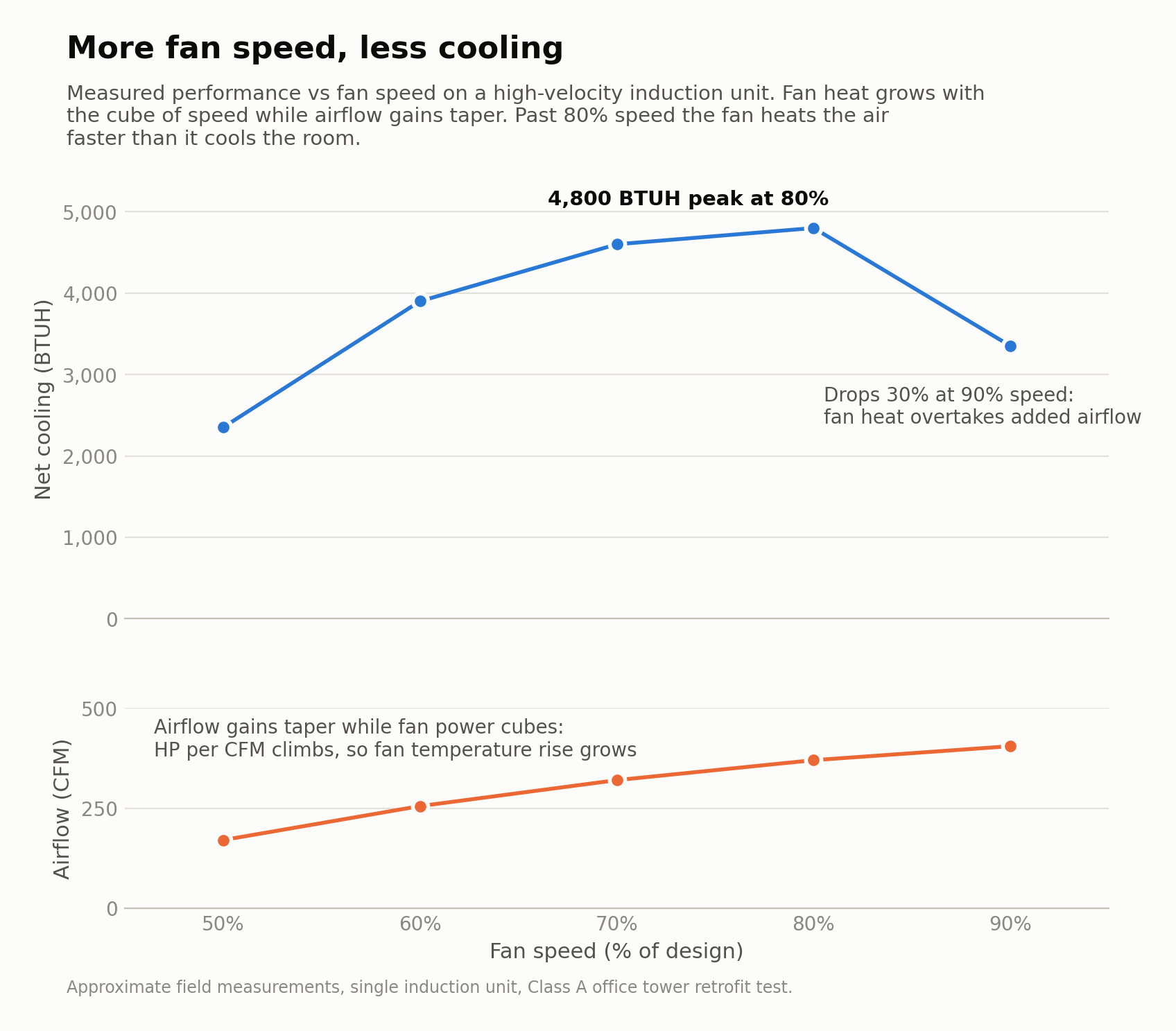
Fan power increases with the cube of speed. That is the affinity law, and it is not a rounding error. Airflow tracks speed roughly linearly at the low end, but on a high-velocity system the gains taper as system pressure climbs. And the first law of thermodynamics is unforgiving: all of the fan's power ends up in the airstream as heat. A fan is, among other things, a heater, and the temperature rise it imposes on the supply air is set by horsepower per CFM. Near the top of the speed range, power is cubing while airflow gains shrink, so that ratio rises steeply.
Each degree of that rise is expensive, because the cooling an induction unit delivers is the temperature difference between its discharge air and the room, typically 55 to 60 F against a 70 F room. With a working difference of only 10 to 15 degrees, every degree of fan heat the cooling coil cannot overcome takes 6 to 10 percent of the cooling off the table.
The measurements showed exactly that. Net cooling climbed from 50 percent speed, peaked between 70 and 80 percent at roughly 4,800 BTUH, then dropped about 30 percent at 90 percent speed. More air, less cooling. The fix cost nothing: capping the fan at 80 percent delivered 43 percent more cooling than running it at 90.
What this means if you operate or own a building
The cube law guarantees a peak exists on any fan-driven system. Where it lands is not universal: it depends on where the as-built velocity landed, so the right answer might be closer to 95 percent on one system and closer to 60 on another. This building's peak was 80. Yours is somewhere else, and the only way to find it is to measure.
The fix required no new equipment, and the cube law pays you twice. A speed cap recovered 43 percent of cooling capacity the building already owned, and the same setpoint change slashes fan energy: dropping from 100 to 80 percent speed cuts fan power by nearly half, and from 90 to 80 percent by roughly 30 percent. More cooling and a smaller electric bill from the same adjustment. The cooling is being lost in delivery, and a day of instrumented testing will show you exactly where it dies between the plant and the people.
To be clear about the end game: the right long-term move is upgrading the induction units themselves to modern low pressure drop units with volume control, which improves the whole curve rather than just finding the best point on the old one. But that is a capital project. Until then, finding your fan speed peak is a simple energy savings hack: real cooling capacity and fan energy recovered with a setpoint change.
Flip the script in winter
The same physics runs in your favor in heating season, when fan heat is not a penalty but supply. For buildings looking toward electrification, once grid carbon intensity drops, running the fan harder in winter becomes a way to displace fossil fuel heating. Fan heat is not the cheapest electric heat to operate; a heat pump delivers roughly three times the heat per kilowatt-hour. But it is by far the lowest installed cost, delivered through fans and distribution the building already owns, with no retrofit at all. The speed that is exactly wrong on a design cooling day may be exactly right on a design heating day. The optimal fan speed is not one number, it is a schedule.
One honest caveat: these are field measurements from one test sequence on one floor, not a laboratory study. The exact numbers will differ in every building. The shape of the curves will not, because the physics does not change.
If your induction building has chronic hot spots and the fan has been sitting at 90 to 100 percent for as long as anyone can remember, the better question is: where is your peak, and are you already past it?